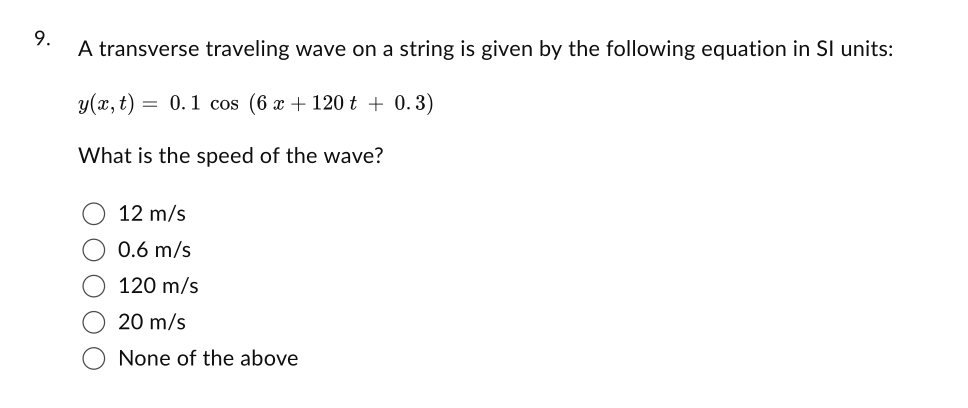
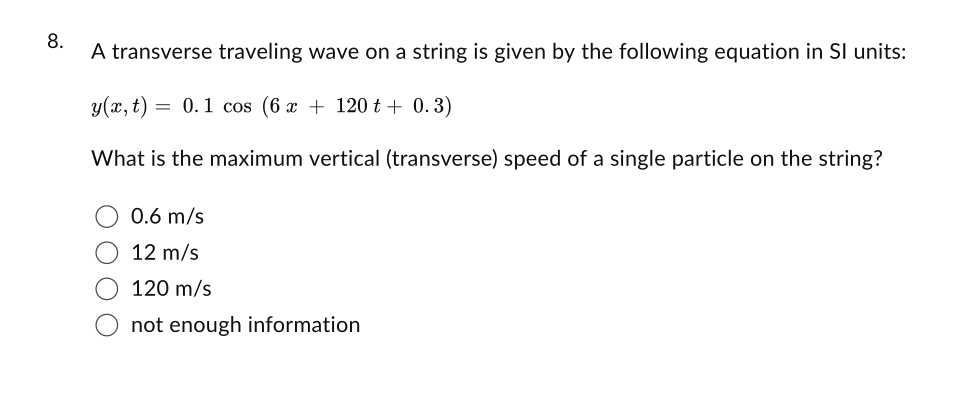
Copyright © Michael Richmond.
This work is licensed under a Creative Commons License.
Copyright © Michael Richmond.
This work is licensed under a Creative Commons License.
When ordinary objects meet, they usually smash into each other, deforming, breaking, and permanently modifying each other. (Go to 0:50 in the video below)
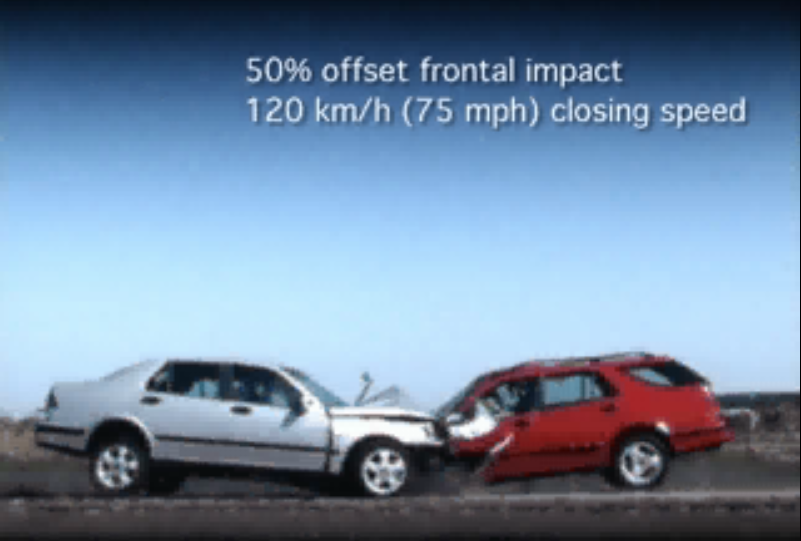
But when two waves meet, something very different happens:
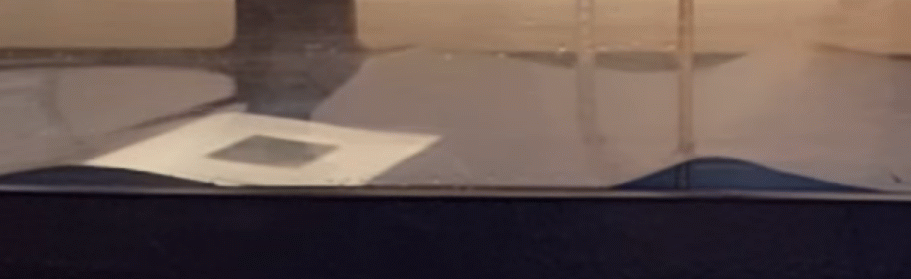
Image and video courtesy of
tsca111
Each wave continues moving at the same speed, in the same direction, with the same shape and size. Waves can and do pass through each other completely unchanged.
In any region where both waves are present at the same time, the result is simply the mathematical addition of the two wave functions: superposition.
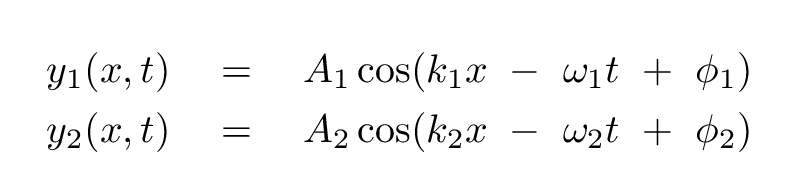
In general, the addition of two arbitrary waves yields a result which is, well, not always easy to understand.

Today, we'll look at two special cases of superposition which produce relatively simple results. In each case, we'll first do the mathematics, and then consider some applications in the real world.
Let's start with a brief review of some jargon.
The two special cases we will cover today involve waves which are very, very similar to each other. They differ only in one small way -- but that small difference can lead to important consequences.
If we have time today, we'll discuss what happens when waves meet some sort of boundary. In particular, we'll consider the case of a wave travelling on a string when it reaches the end of that string. This information will be very handy in the experiment you will perform in our next class meeting.
Copyright © Michael Richmond.
This work is licensed under a Creative Commons License.