 Copyright © Michael Richmond.
This work is licensed under a Creative Commons License.
Copyright © Michael Richmond.
This work is licensed under a Creative Commons License.
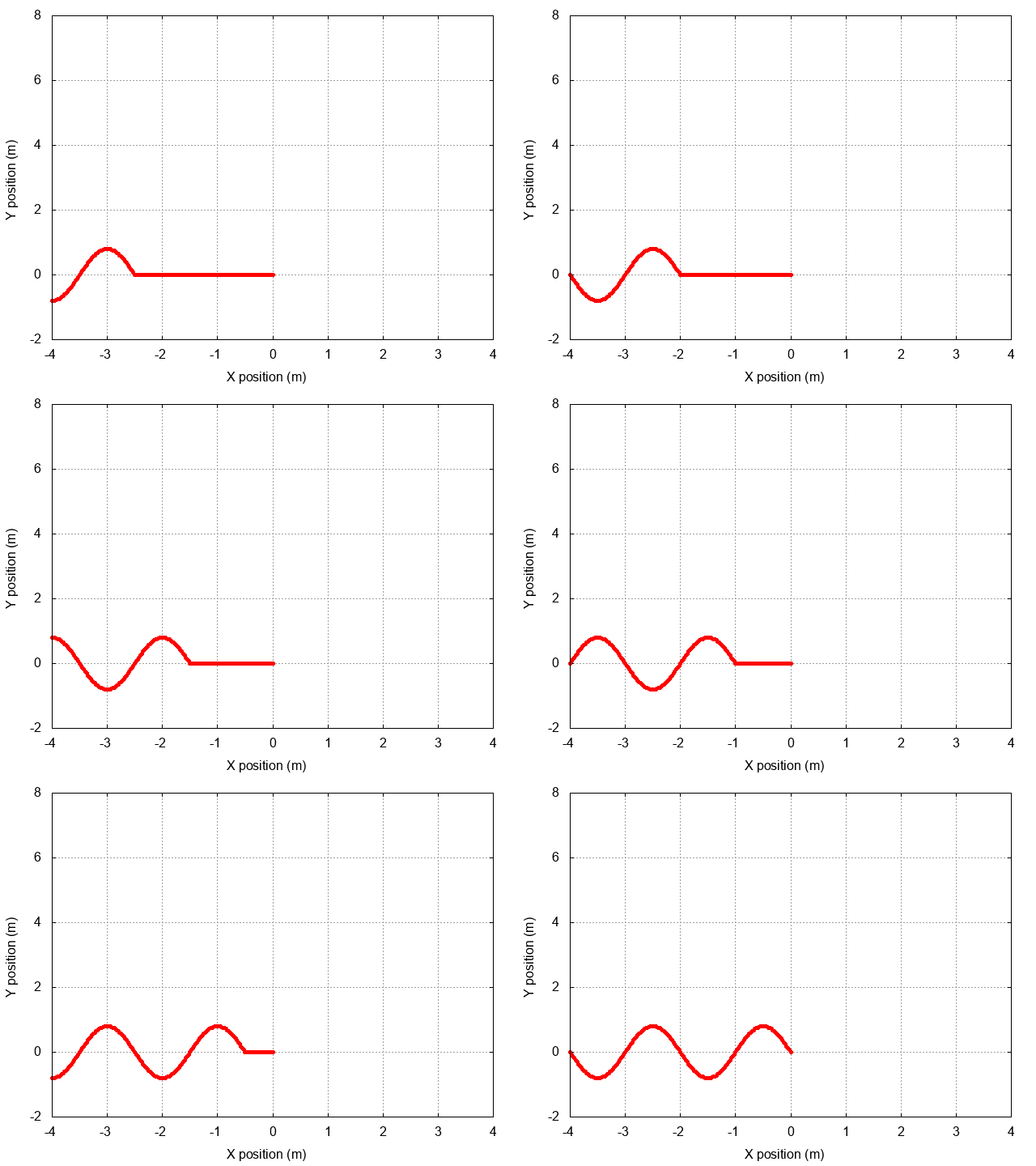
Let's consider a complicated situation. Suppose that a very long string is tied to a motor at its left end, and to a fixed point on a wall at its right end. Initially, the string is at rest. But when we turn on the motor, we create a wave which travels along the string to the right. If the motor drives the end of the string in a sinusoidal manner, with angular frequency ω, then we can describe the incoming, or incident, wave, like so (note the subscript i for "incident")

The wave number k will depend on the speed of waves travelling along the string, which, in turn, depends on the values of the tension T and mass density M/L.
The situation will look something like this as the wave approaches the wall:
When the wave reaches the wall, some rather complicated stuff will happen. In order to make it easier to see the details, let's show just the first half-wavelength of the incoming wave.
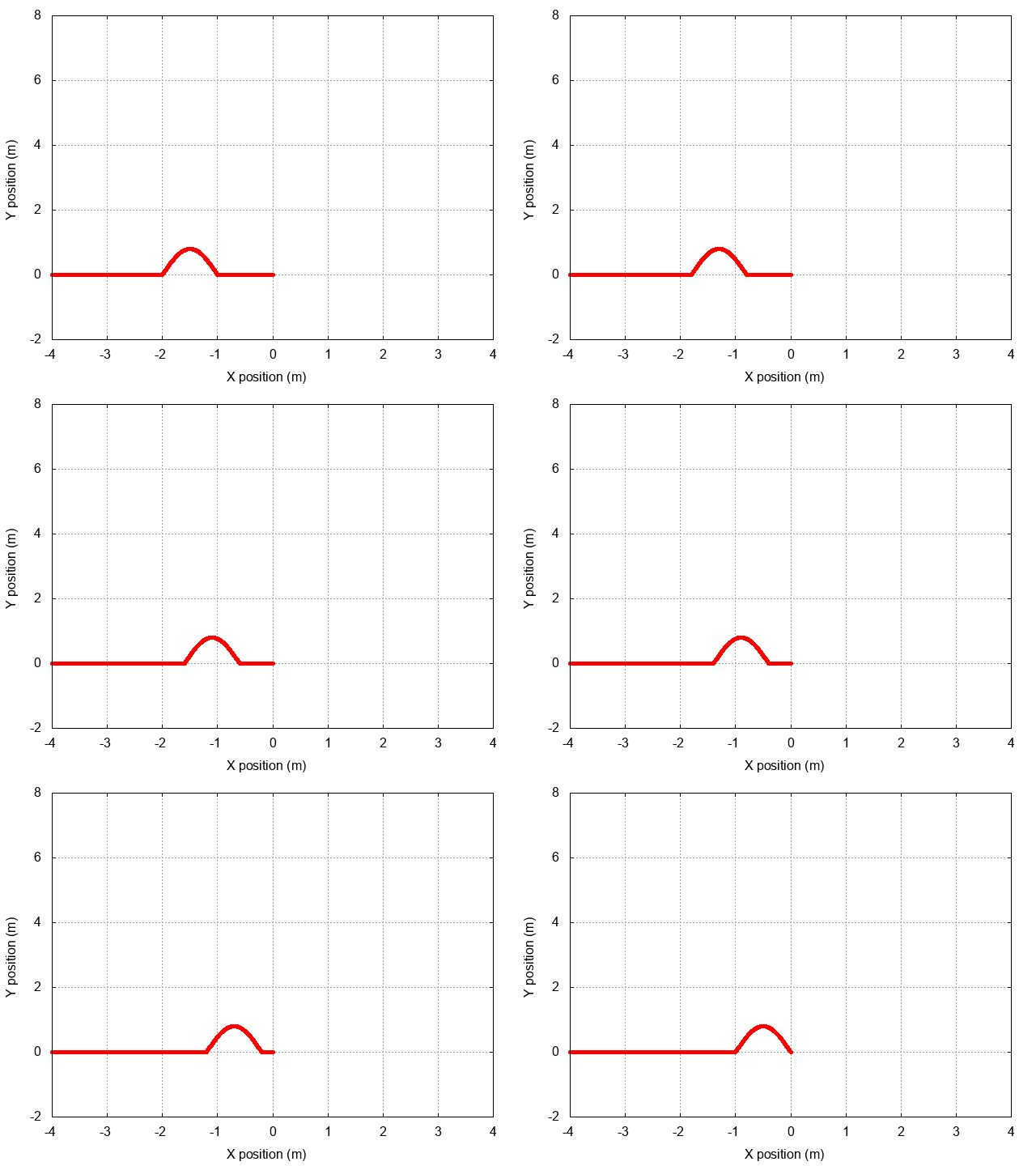
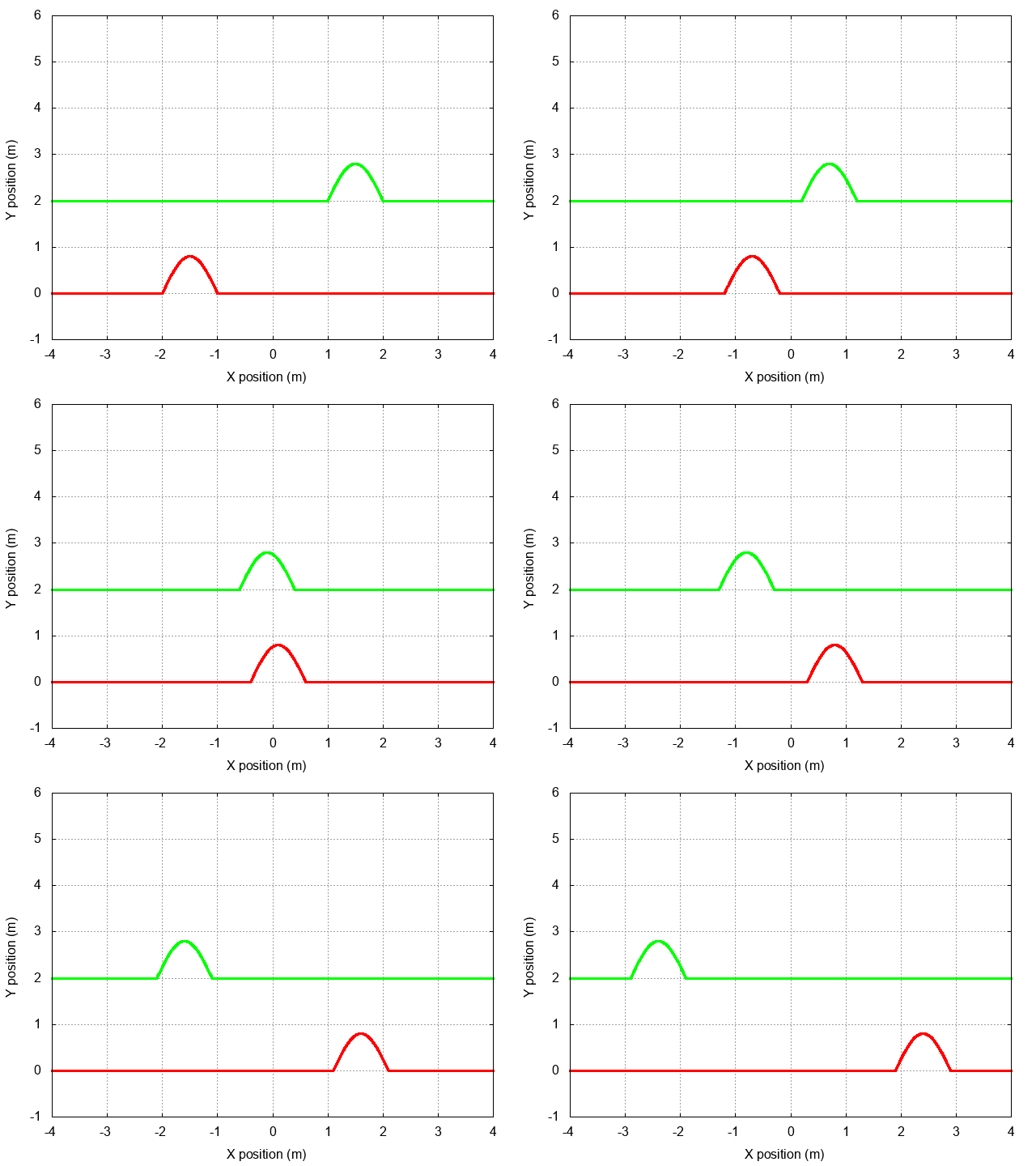
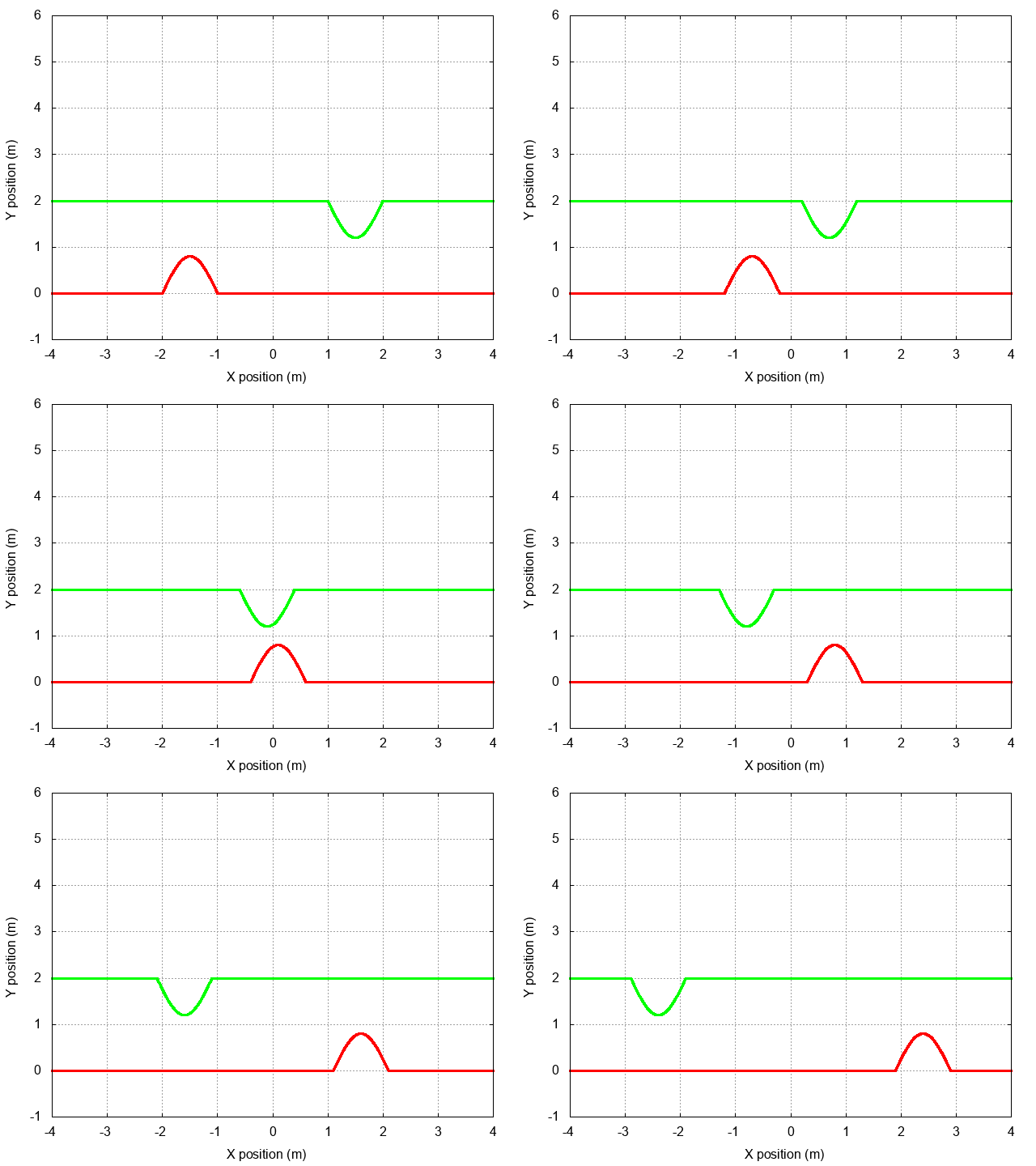
Something is going to happen when the wave reaches the fixed end at x = 0. We might guess that a new, "reflected" wave will start moving along the string in the opposite direction, to the left.
But exactly what sort of reflected wave will appear? It might look like the incident wave -- an "exact copy", one might say:
It might look like a "inverted" version of the incident wave:
Or it might look like something else. Which of these possibilities -- if any -- matches the actual behavior of a wave on a string?
  So, what do you think will happen when a wave reaches the
       tied-down end of its string?


    a) the wave stops and disappears

    b) a new wave which looks exactly like the original --
            the "exact copy" -- will start moving
            in the opposite direction

    c) a new wave which looks like an upside-down version of the original --
            the "inverted copy" -- will start moving
            in the opposite direction

    d) something else
If one goes through all the math, one finds that the equation of the reflected (yr) wave must look like

It may not look like it, but this equation for the reflected wave yields a wave which is INVERTED --- at the special boundary location x = 0 -- relative to the incident wave.
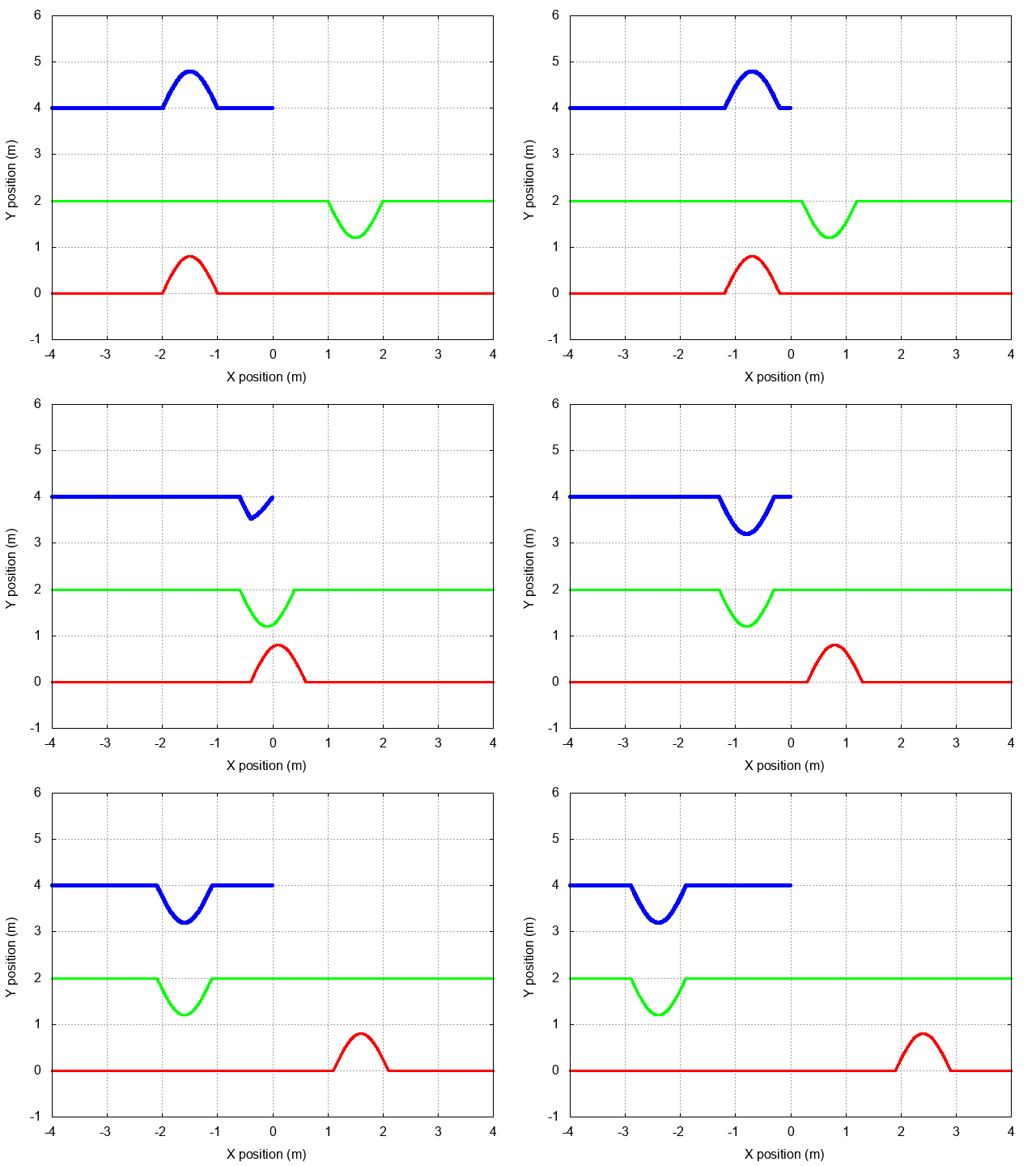
And so when the incident wave (in red) reaches the end of the string, the reflected wave (in green) must have an INVERTED displacement, but the same wavelength and angular frequency and speed, as the incident one. Note the somewhat strange shape of the sum of the two (in blue) during the first few moments after the incident wave reaches the end of the string. But also note that this sum is always exactly zero at the endpoint.
The title says it all. Do real waves running down a string produce INVERTED versions of themselves when they reach a fixed end of the string?
Thanks to the people at School of Physics, UNSW, in Sydney, Australia, we can find out. Click on the image to show the movie, and pay attention to the upper panel.
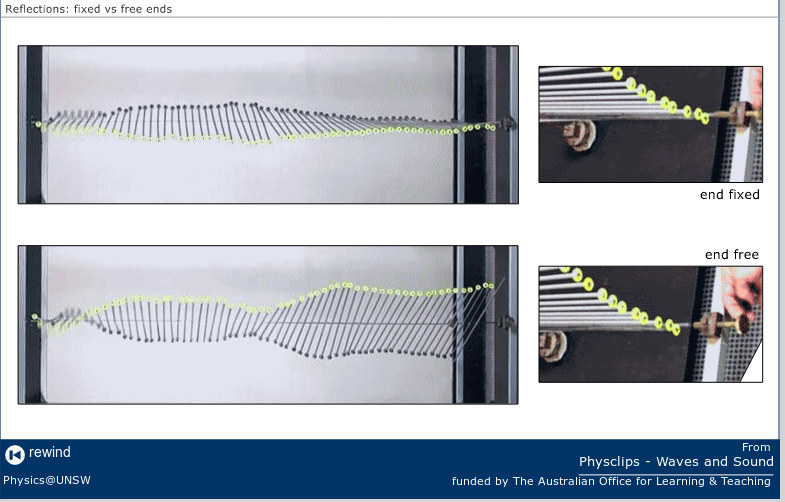
Image and movie courtesy of
School of Physics, UNSW, in Sydney, Australia,
Here's a closeup of the moment when the wave first reaches the fixed end of the string. Note the correspondence of theory and experiment.
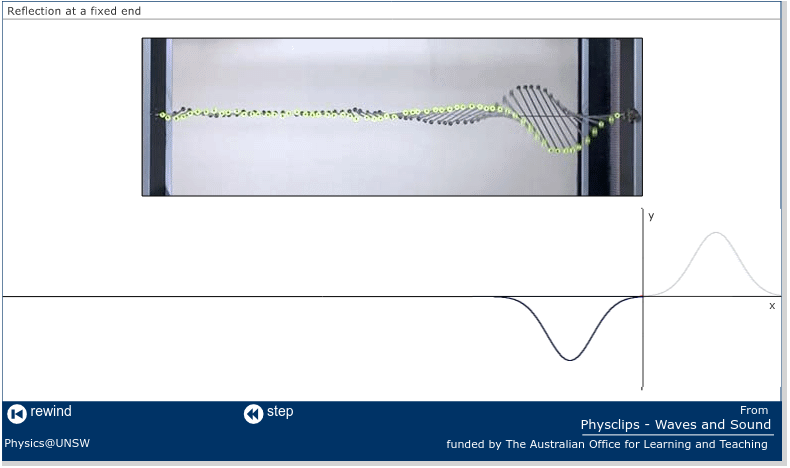
Image and movie courtesy of
School of Physics, UNSW, in Sydney, Australia,
So, yes, real waves do agree with theory.
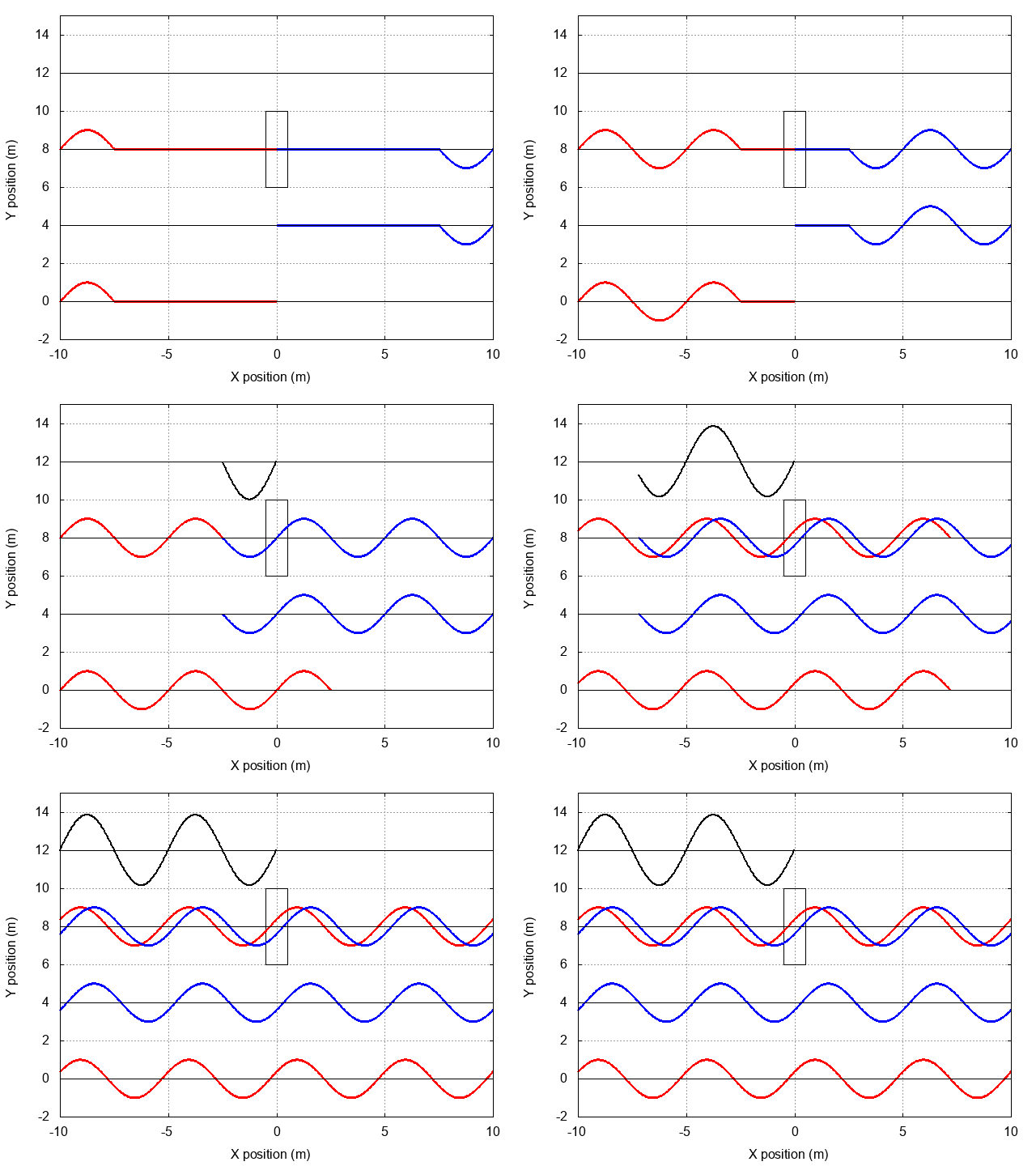
Things are bit more complicated if we show the full incident and reflected waves, but if you watch the animation below several times, it should start to make sense. Focus on the black box centered on x = 0 to see that the incident and reflected waves always add up to zero at that location.
   sum of incoming and outgoing


   incoming (red) and reflected (black)


   reflected wave (black)


   incoming wave (red)
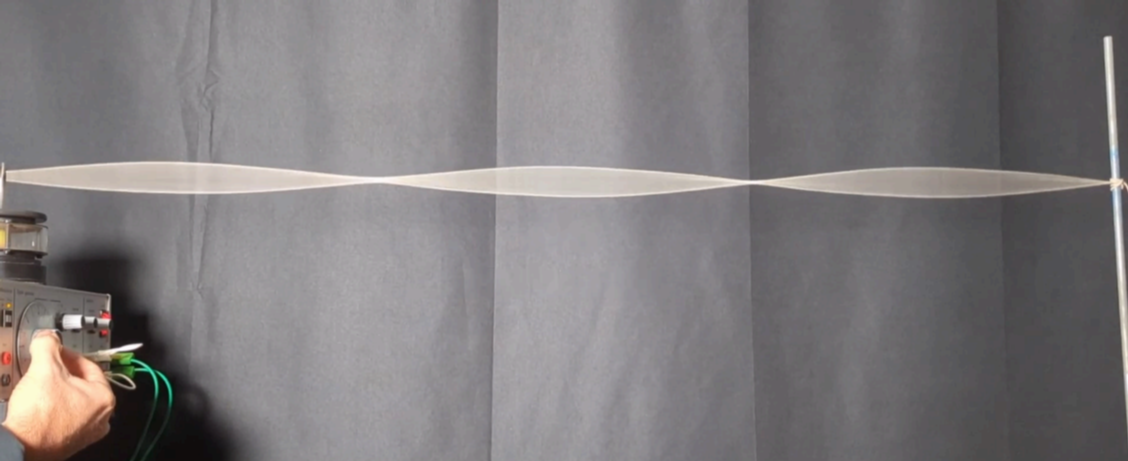
The uppermost region of the graph shows the sum of the incident and reflected waves on the string. The sum is simply a standing wave that propagates back along the string, away from the wall.
Copyright © Michael Richmond.
This work is licensed under a Creative Commons License.