 Copyright © Michael Richmond.
This work is licensed under a Creative Commons License.
Copyright © Michael Richmond.
This work is licensed under a Creative Commons License.
Just how can one figure out the amount of mass in a stellar system, or a galaxy, or any other collection of objects, from the motions of objects within it? That sounds pretty complicated. Let's start with a simple situation in order to see the basic idea.
Our Solar System consists of
In this case, almost all the mass resides in one object, the Sun, which sits at the center of the system.
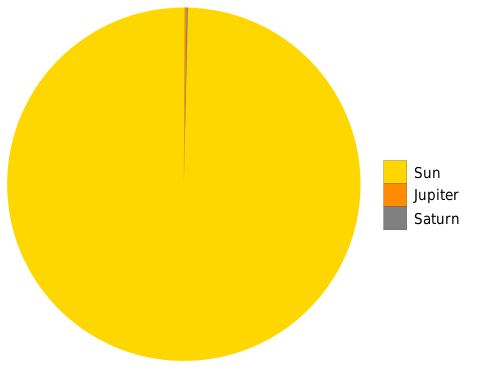
Graph courtesy of
Das steinerne Herz and Wikimedia
For our purposes, we can ignore all the gravitational interactions which don't involve the Sun. That means that the motion of every planet is very simple, due only to the gravitational force of the Sun.
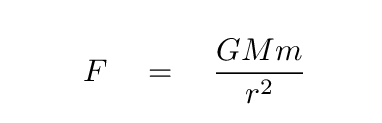
For objects in circular orbits, we can equate the centripetal force on the object to the gravitational force from the Sun.
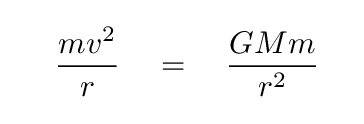
  Q:  Can you solve this equation for the velocity as a function
                of radius?
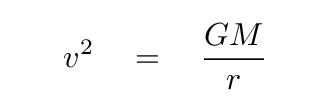
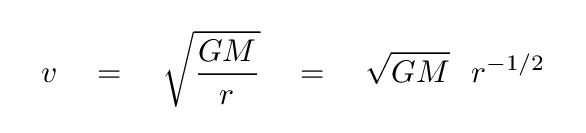
When we measure the speeds of planets and asteroids in our Solar System, we find exactly this sort of relationship. It is often called "Keplerian motion", as it is consistent with the rules Johannes Kepler described in his work.
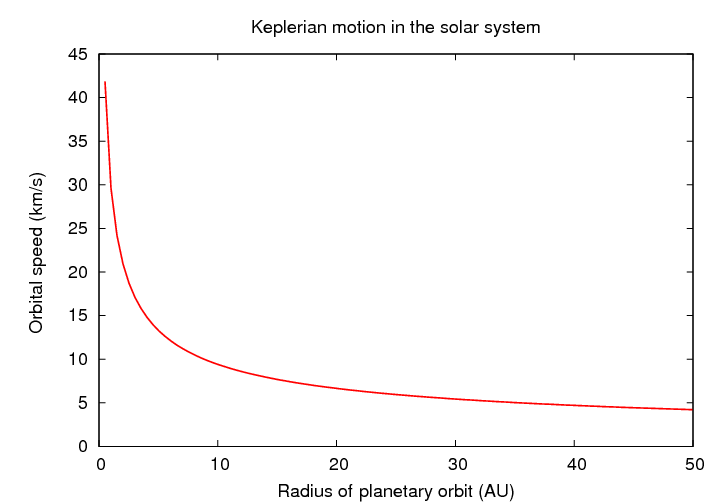
Notice how quickly the orbital speeds decrease with radius.
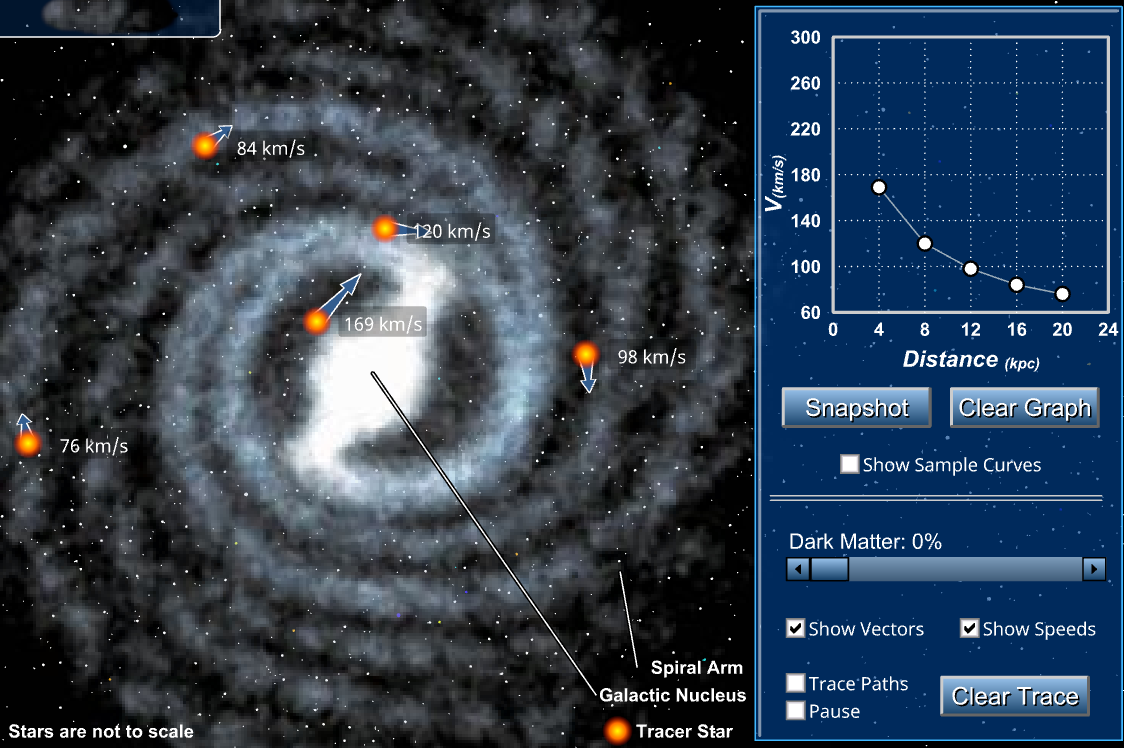
Now, exactly the same mathematical argument can be applied to galaxies. Spiral galaxies like the Milky Way are, to a decent approximation, flat disks made up of billions of stars which are moving in circular paths around the center of the galaxy. In other words, the motions of stars in the disks of spiral galaxies should be pretty similar to the motions of planets in our Solar System, or exoplanets around any other host star.
If most of the mass of a galaxy lies at its center, then the orbital speed of stars in it should decrease with distance away from the center. A graph of these orbital speeds as a function of radial distance -- also known as a rotation curve for short -- should show a sharp decrease.
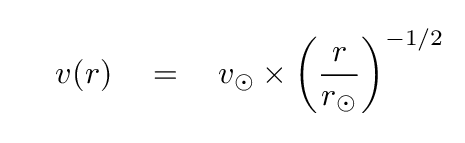
We can be a bit more quantitative. If we know the rotational velocity at some orbital radius -- such as the Sun's radius -- then we can compute the velocity at any other radius like so:
Let's use these values:
   solar distance from galactic center  R🞊  =  8 kpc

   solar orbital velocity               V🞊  =  235 km/s
Assuming that our Galaxy's mass is all concentrated at the center, use the formula above to compute the orbital speed of objects at these distances.
     Orbital radius  r              Keplerian velocity v(r)
        (kpc)                               (km/s)
 --------------------------------------------------------------

         2.0

         4.0

        10.0

        15.0

        20.0

        30.0

 --------------------------------------------------------------
That's a clear prediction. Let's try to compare it to the motions of stars in some other spiral galaxies.
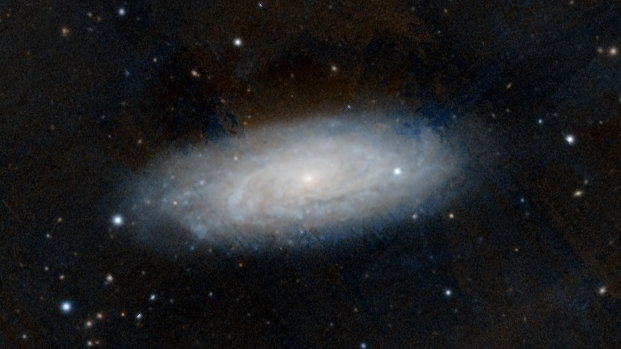
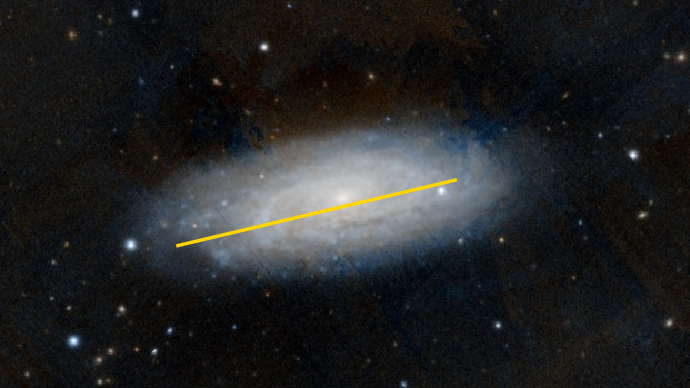
During the 1970s and 1980s, Vera Rubin spent years observing a number of carefully chosen spiral galaxies with large telescopes. She and her collaborators chose galaxies which were not far from edge-on, in order to minimize the effects of errors in the inclination on calculations. For example, NGC 4062:
Rubin and colleagues used long-slit spectrographs, placing the slit so it ran along the major axis, though the center and extending far to each side. Their spectra showed features due to several strong emission lines of gas in HII regions, excited by the hot young stars in the arms of these galaxies.
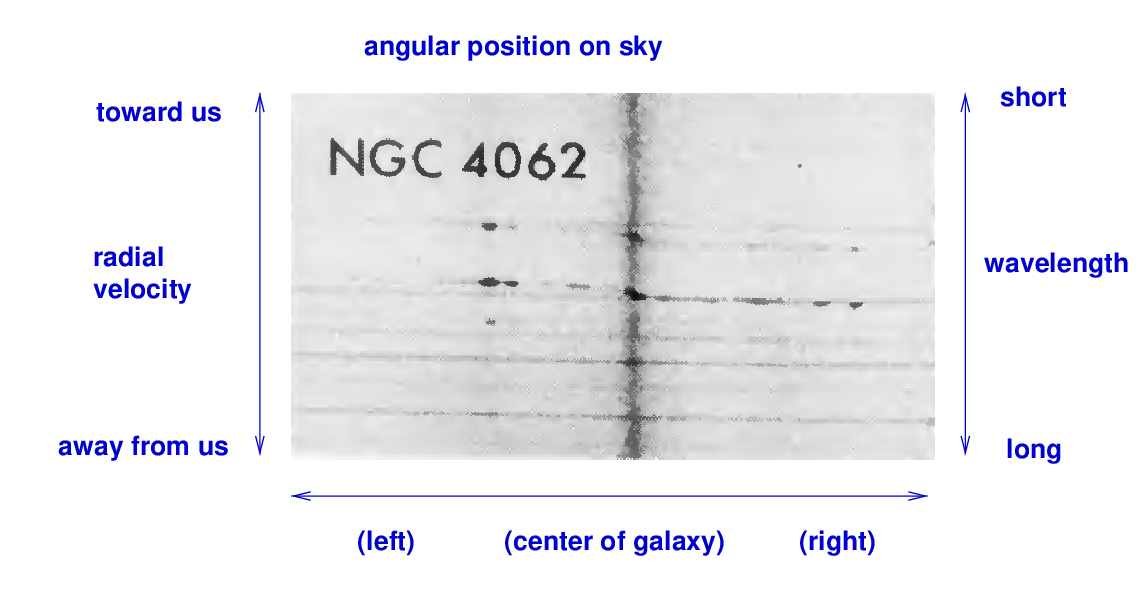
Spectrum of NGC 4062 (with added annotations)
from Plate 17 of
Rubin, Ford, and Thonnard, ApJ, 238, 471 (1980)
Note that the emission from each line shows the same pattern: gas on one side of the galaxy is moving toward us (relative to the center of the galaxy), while gas on the other side is moving away from us. These spectra reveal the motions of the clouds of gas within the spiral arms -- which must be the same as the motions of the stars in and around those clouds.
Quantitative measurements of the wavelength of the emission lines allow one to compute the velocity of the stars in the galaxy from one side to the other. This particular galaxy, NGC 4062, is one of just 21 spirals described in a paper published by Rubin et al. in 1980.
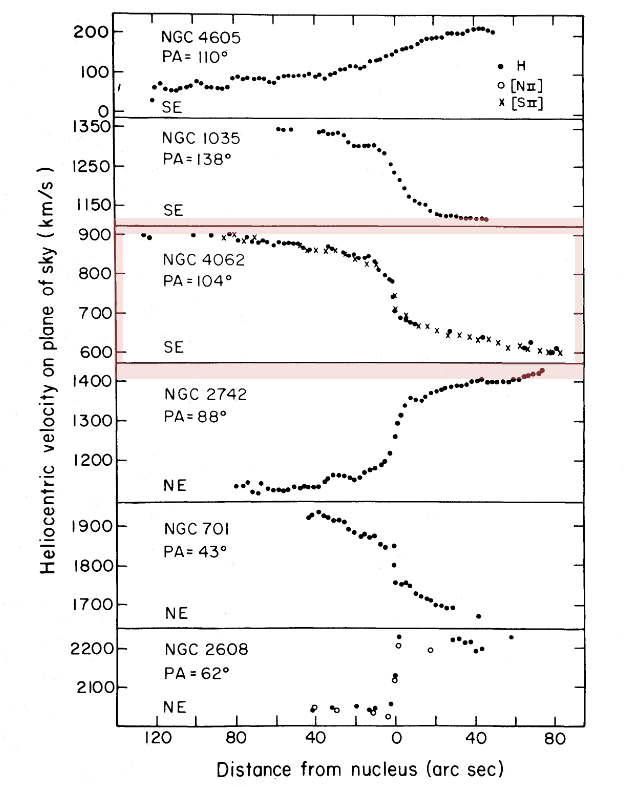
Rotation curve of NGC 4062 and other galaxies,
from Fig 4 of
Rubin, Ford, and Thonnard, ApJ, 238, 471 (1980)
  Q:  What is the velocity of the center of NGC 4062, relative
         to the Sun?

  Q:  What is the velocity of gas at the left-hand edge of
         NGC 4062, relative to the Sun?

  Q:  What is the velocity of gas at the right-hand edge of
         NGC 4062, relative to the Sun?

  Q: Roughly how fast are stars and gas in the disk of
         NGC 4062 orbiting around the center of that galaxy?
Let's compare the observed rotation curve of NGC 4062 with the theoretical rotation curve of a system in which all the mass sits at the center.
One can summarize the results of Rubin et al.'s studies of spiral galaxy rotation curves in a single figure (as they did in their Figure 6). It shows the orbital speed of gas and stars in the galaxies as a function of distance away from the center of the galaxy.
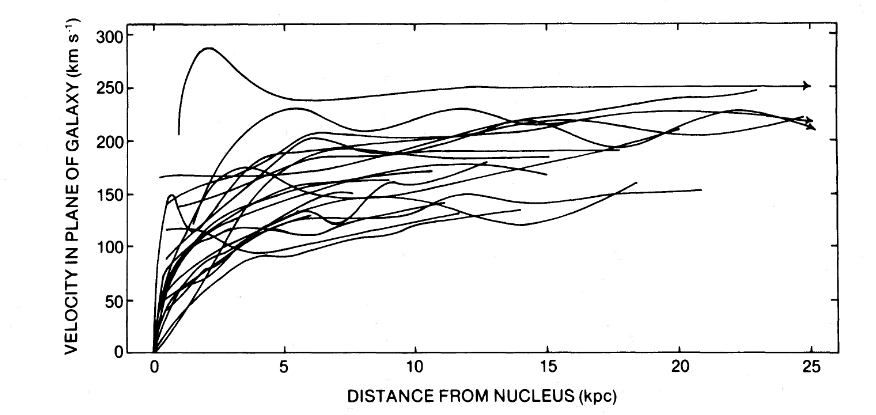
Scaled and superposed rotation curves of 21 spiral galaxies,
from Fig 6 of
Rubin, Ford, and Thonnard, ApJ, 238, 471 (1980)
  Q:  Do the orbital speeds of gas and stars decrease
          as one looks farther and farther from the centers
          of these galaxies?
No, the rotation curves do NOT decrease with distance. In fact, in many cases, the continue to increase slightly as far out as we can measure them. At the very least, one can say that the great majority of spiral galaxies have rotation curves which don't fall with radius, but are flat.
Yet these measurements are made in the outermost visible reaches of the galaxies. In the case of NGC 4062, the measurements extend roughly along the gold line.
  Q:  How much of the LIGHT of the galaxy lies within the
         measured region?

  Q:  How much of the MASS of this galaxy falls within the
         measured region?  Explain your reasoning.
In their 1980 paper, Rubin, Ford, and Thonnard write in their Conclusion section,
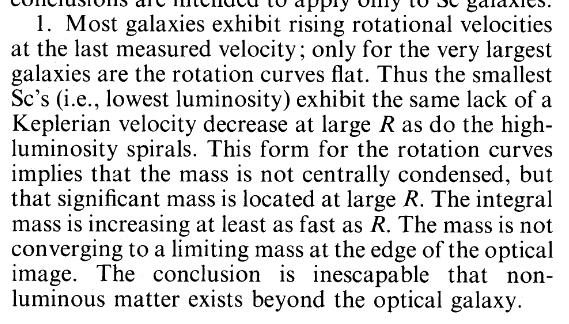
That phrase "non-luminous matter" sounds a bit awkward. I wonder if there's a snappier way to write it ...
Copyright © Michael Richmond.
This work is licensed under a Creative Commons License.
