 Copyright © Michael Richmond.
This work is licensed under a Creative Commons License.
Copyright © Michael Richmond.
This work is licensed under a Creative Commons License.
Before today's class, you were asked to read this paper by Cai and Wang:
The Hubble Tension: A Decade Review (Research in Astronomy and Astrophysics, 26, 084011 (2026)
You were also asked to answer several questions, based largely on material from the Introduction of the paper.
What does "Late Universe" mean? We are living in the Late Universe! It's been about 13.7 billion years since the Big Bang, which is quite a long time; hence the name "Late." If we make measurements of the rate at which the universe is expanding now, then we'll be determining the "Late Universe" expansion rate.
Edwin Hubble and the other astronomers who started the whole field of modern cosmology were focused on relatively nearby galaxies; after all, those were the only ones close enough and bright enough to measure in detail. Those early values involved two types of measurements of nearby galaxies:
Here's the crux of the problem: there is JUST ONE really reliable method of measuring distances to objects in space: parallax. It yields distances which can be both precise (better than 1 percent) and accurate. The problem is that it only works for relatively small distances:
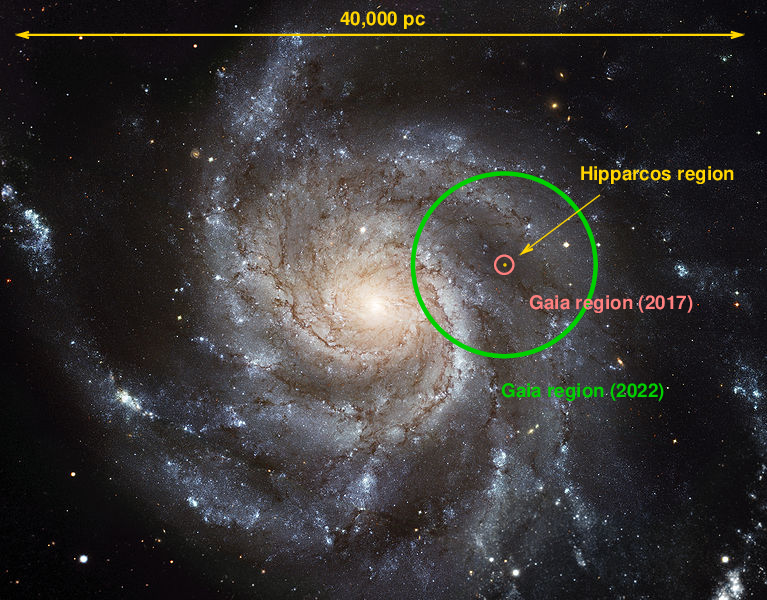
Using parallax, we can't even determine the distance to the far side of our own Milky Way Galaxy, let alone to other galaxies -- which are hundreds or thousands of times farther away. Argh!
  Q:  What can astronomers do to measure -- or at least estimate --
         the distances to objects which are much farther away?
The answer is to build a distance ladder:
The problem with this approach is that if any of the methods involved in the ladder have an error ... then all the results after that point share the error, too.
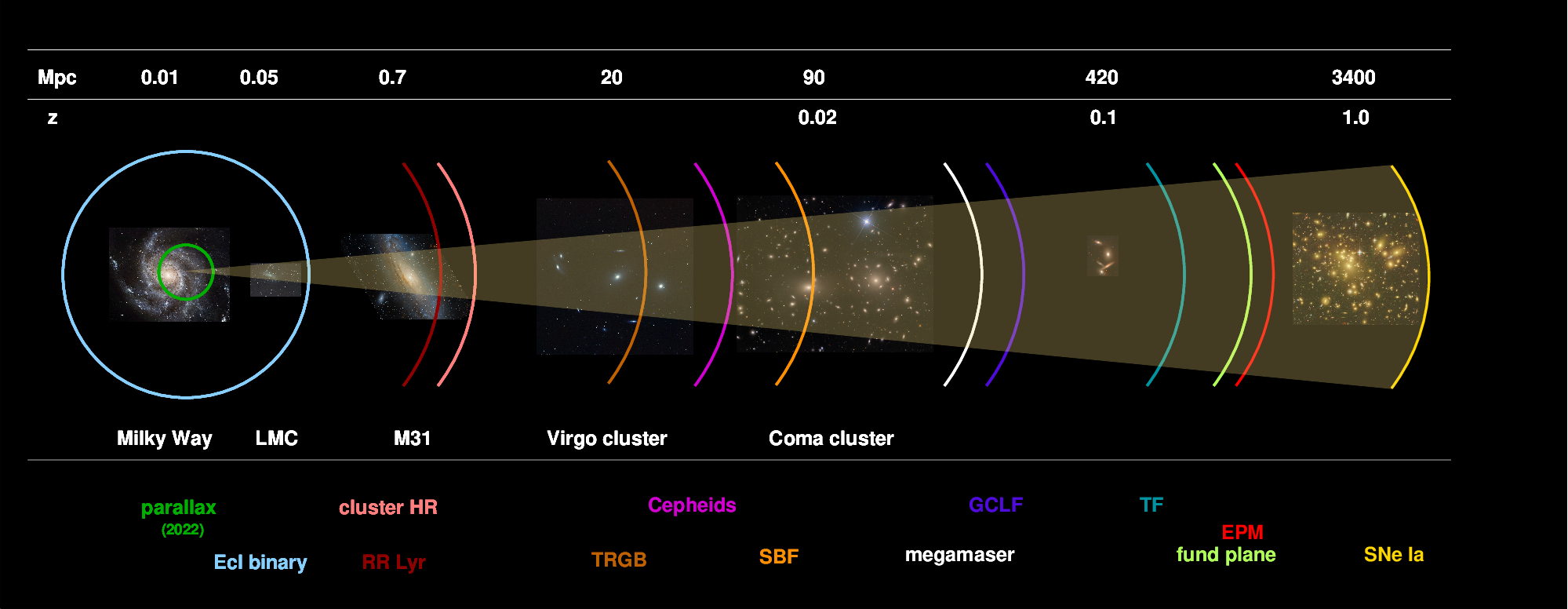
This method of building a local "distance ladder" and using it to measure the relationship between velocity and distance yields a value of H0 = 74-ish +/- 3-ish km/s/Mpc.
There is a very, very different way to determine the properties of the universe which depends largely upon measurements of the Cosmic Microwave Background (CMB), but also leans heavily upon theory. At least, it leans more heavily on theory than the "Late Universe" method.
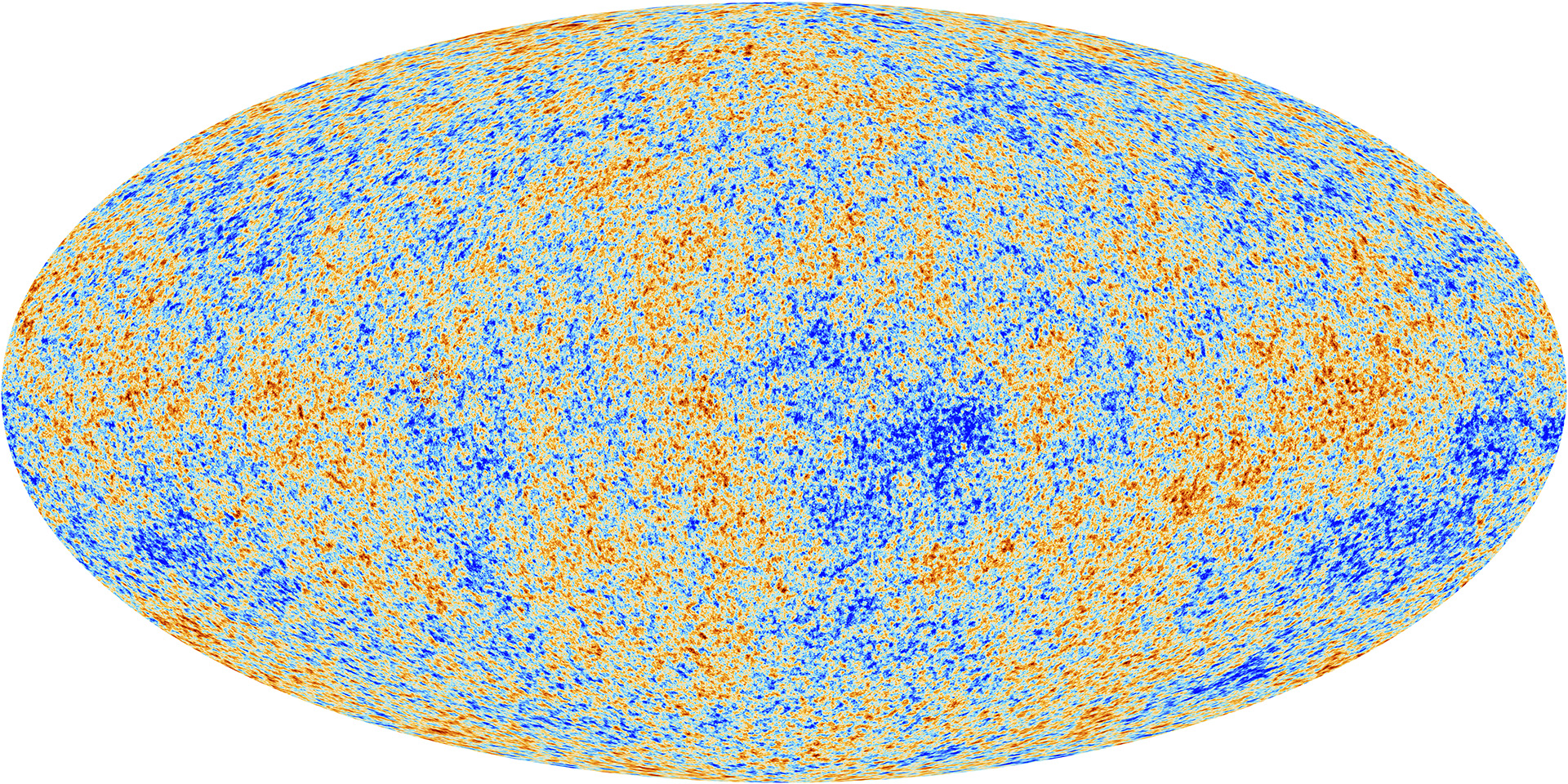
Image courtesy of
ESA and the Planck Collaboration
It's not quite so easy to explain this technique; for a long explanation, please visit
Here's a quick attempt at the general idea: very early in the universe's evolution, space was filled with a dense, hot gas. Over time, this gas cooled down and grew less dense as the universe expanded. On average, the gas had nearly the same density everywhere ... but if one looked very closely, some regions were SLIGHTLY more dense than others, and some were SLIGHTLY less dense.
Consider one little region of gas in the early universe -- at some time between t = 3 minutes and t = 300,000 years. Suppose that, by some random set of collisions and motions, this region at some moment happens to end up with a slightly higher-than-average density.
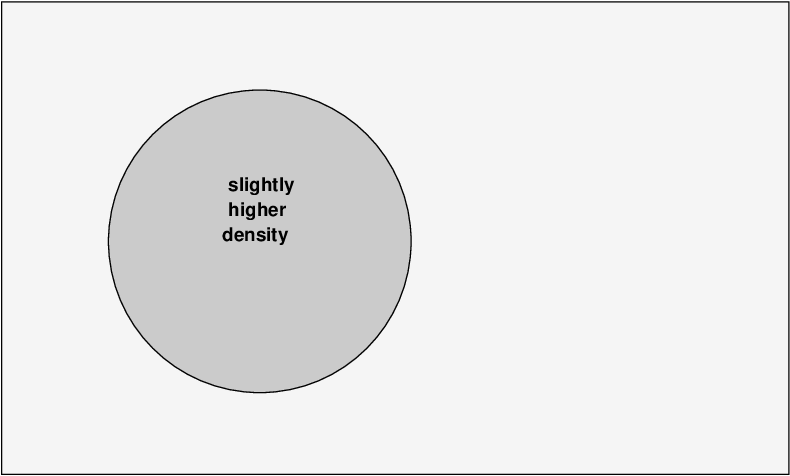
The gravitational force of the clump will pull gas from the surrounding region inwards, increasing the density of the clump.
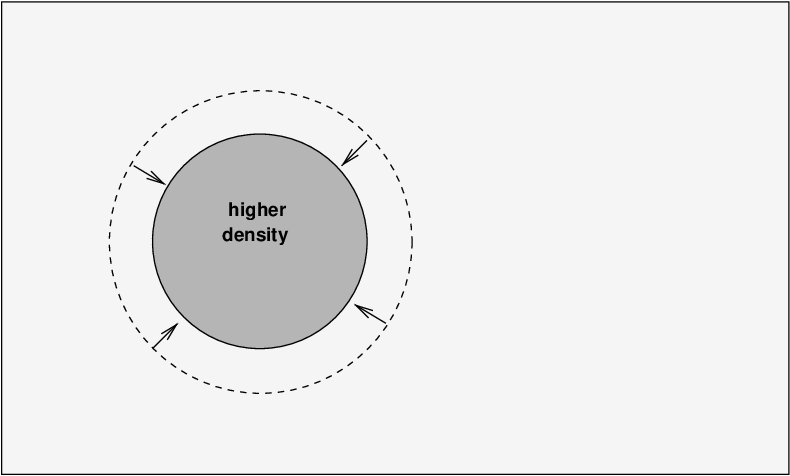
However, as the clump shrinks, the density and temperature of the gas inside rises. Recall that, in addition to the MATTER inside this clump -- protons and electrons and neutrons -- there are a bunch of PHOTONS trapped within it as well. At this point in the evolution of the universe, the electrons are running free of the nuclei, the gas is fully ionized, and as a result, it is opaque. Photons can't escape from the clump, so they are pressed closer together as it shrinks. The radiation pressure from the photons helps to push back against this contraction.
Eventually, after reaching a minimum size, the clump stops collapsing and begins expanding again. It grows larger, reaching its initial size ...
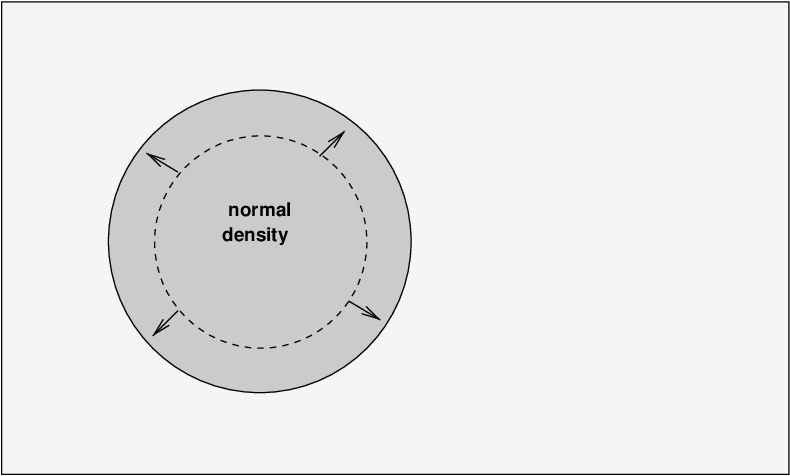
... but then the momentum of the expansion causes the gas to overshoot, and the cloud grows even larger than it was originally.
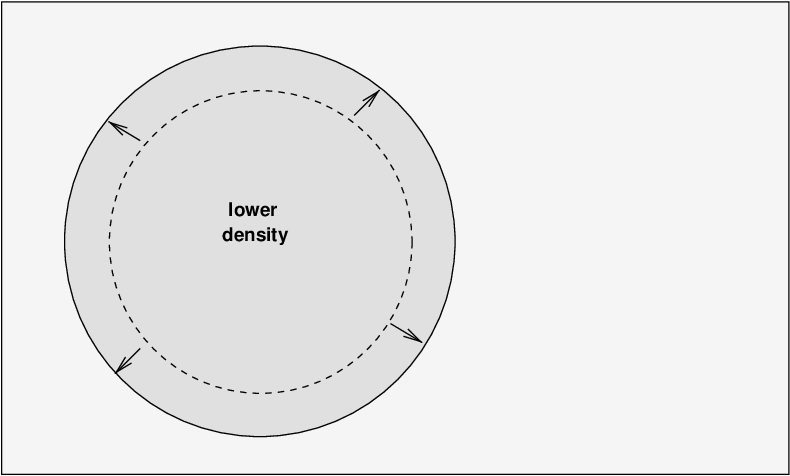
Of course, now the cloud is LESS dense than the surrounding gas, and has a lower pressure as well. The pressure of the material around halts the expansion and causes it to contract again ...
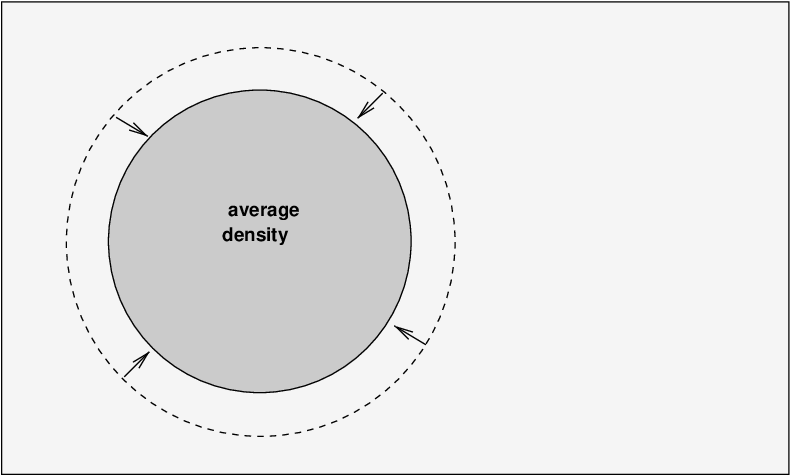
... but, again, it overshoots the original size and starts shrinking again.
To summarize, small random variations in density in the early universe can set up regions in which the gas oscillates in and out, growing and shrinking, for long periods of time.
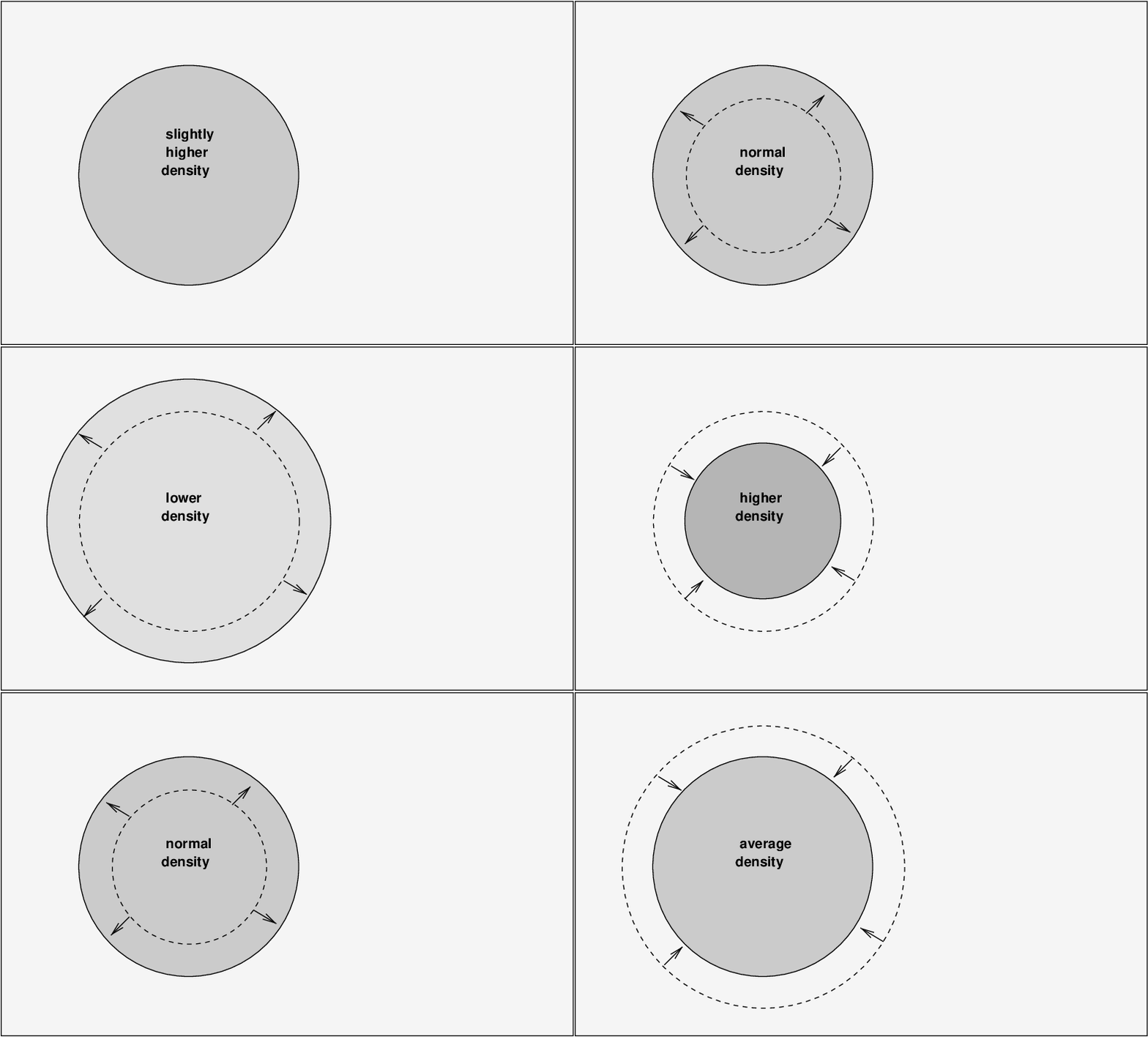
The outer edges of the clump expand and contract by pushing outward against the ambient gas, then being pushed back inward. The boundary between clump and ambient gas moves at the speed of sound vs, and so this phenomenon is often called acoustic oscillations.
How big are these clumps? There are many different sizes -- big ones, small ones, intermediate ones. The one thing they share is the speed with which their boundaries move: all of them expand and contract at the speed of sound.
This oscillation is driven in part by the pressure exerted by both physical particles (protons, electrons, etc.) and photons inside the clumps. However, at a time about 300,000 years after the Big Bang, the average gas temperature cools enough that electrons and protons become to combine to form neutral hydrogen. The opacity of neutral hydrogen is MUCH SMALLER than that of ionized gas, and so photons can finally fly long distances before interacting with any gas particles; in other words, the mean free path becomes effectively infinite.
  Q:  What happens to the radiation pressure which had been
         helping to resist the contraction of overdense regions?
Exactly: these acoustic oscillations stop at this time.
When the photons leave a clump, they carry with them a bit of information about the gas within that clump. The temperature in a dense clump is higher than the average value, so the photons leaving a dense clump have a slightly higher energy than average. Likewise, the photons streaming out of a region of low density will have slightly lower energies than average. These small differences in energy remain unchanged as the photons fly through universe, for billions and billions of years ... until our telescopes collect them.
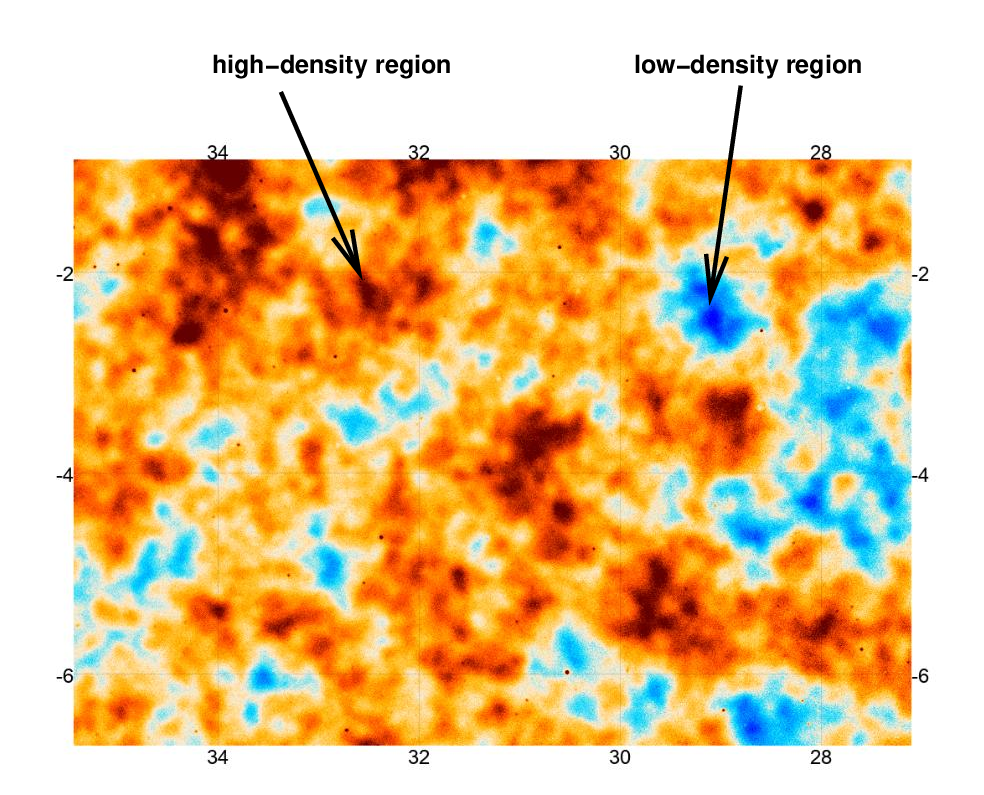
Image taken from
Mallaby-Kay et al., ApJS 255, 11 (2021)
We can (via a rather complex procedure) use the apparent angular size of these "hot spots" and "cold spots" in the CMB, together with the measured redshift of the microwaves, to estimate a LOT of physical parameters in the universe way back at the time that electrons were first captured by protons to make hydrogen atoms. In addition to the Hubble constant, this method provides constraints on other factors such as the mysterious "dark energy" and the nature of the initial little perturbations in density of the primordial gas.
This method of using features in the CMB (and some theory) to measure the relationship between velocity and distance yields an "Early Universe" value of H0 = 67-ish +/- 1-ish km/s/Mpc.
Copyright © Michael Richmond.
This work is licensed under a Creative Commons License.