-
284
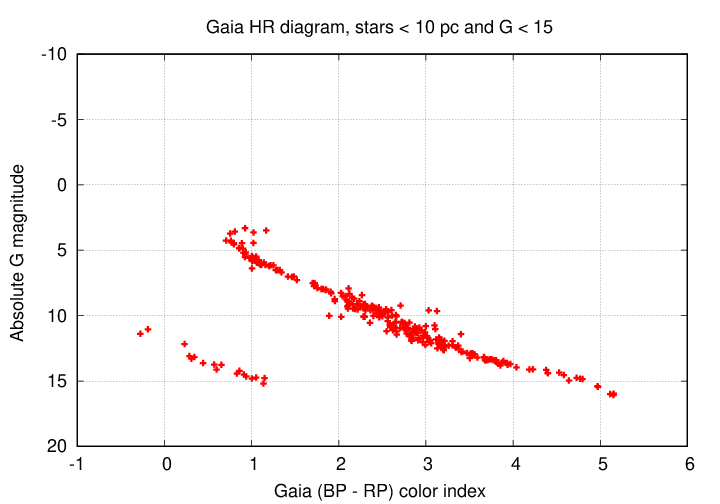
- How many stars lie on the main sequence? What percentage of all the stars is this?
- How many stars are white dwarfs? What percentage of all the stars is this?
- How many stars are giants? What percentage of all the stars is this?
-
266 = 94 percent
-
18 = 6 percent
-
0 = 0 percent
- Are there any giants within a sphere of radius 20 pc?
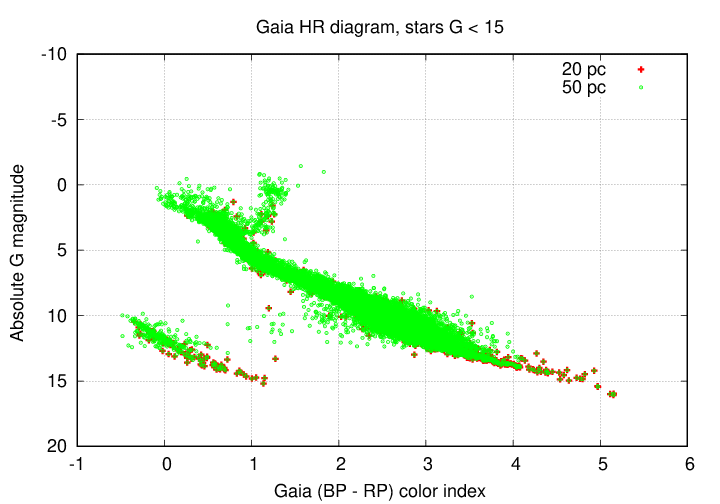
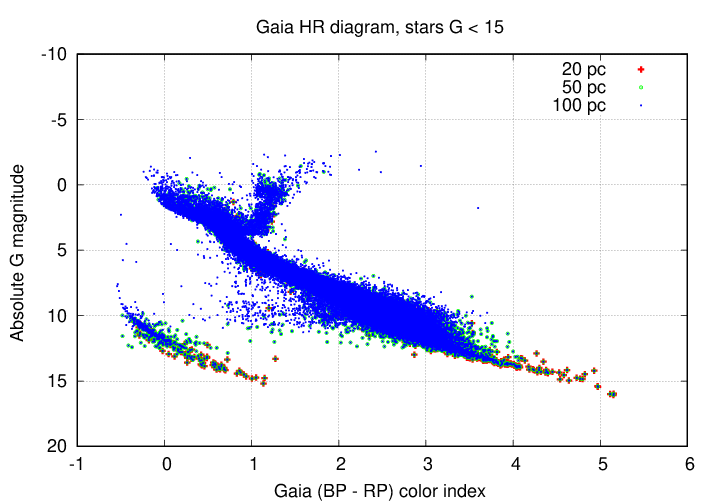
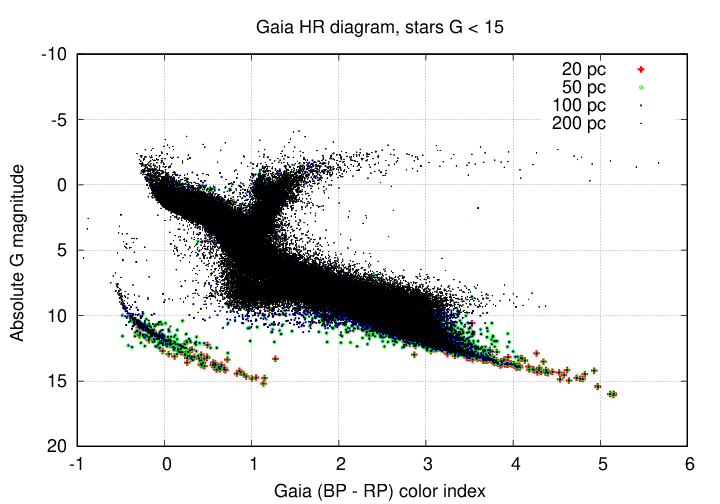
- Roughly how far out must you search to find enough giants to fill out the "giant branch" of the HR diagram?
- Why might it be difficult to measure the properties of these giant stars accurately?
-
Not really -- just 7 stars starting to leave the main sequence
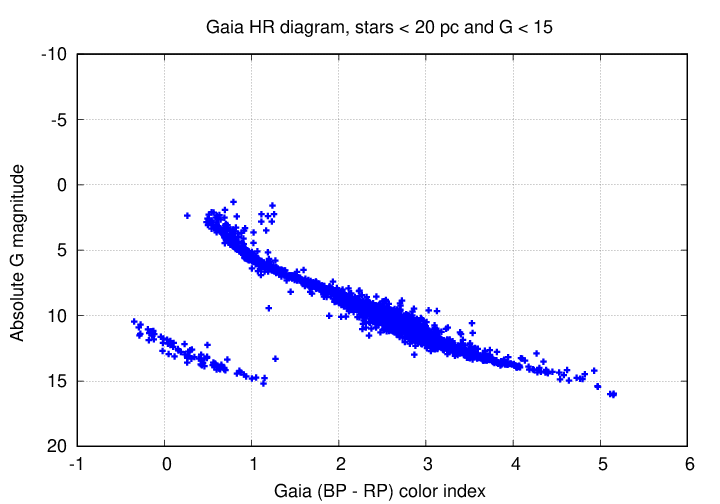
-
At 50 pc, the giant branch fills to the red clump.
At 100 pc, the giant branch starts to reach the supergiant region.
At 200 pc, the giant branch is completely filled.
-
Stars at large distances have very small parallax values,
which are really hard to measure accurately. At a distance
of 100 pc, for example, a star's parallax is only 0.010 arcseconds.
As a general rule, the uncertainty in parallax should be less
than one-tenth of the measurement to be reliable.
So, in order to compute accurately the luminosities of stars
at a distance of 100 pc, we must be able to measure
the parallax shift of a star down to 0.001 arcseconds!